

The intake line is already long.
The phone rings anyway.
Someone needs help now—not after three forms, two approvals, and a spreadsheet update no one remembers to finish.
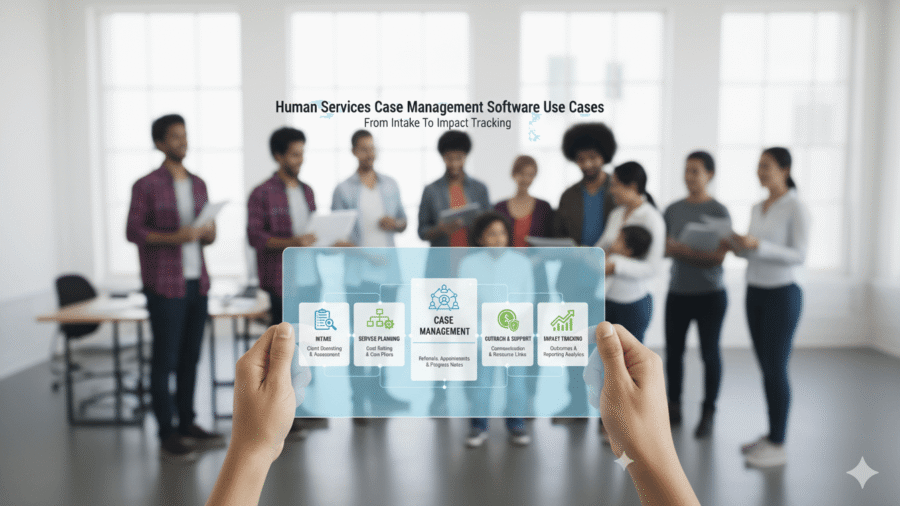
This is the daily reality for human services teams. And it’s exactly where human services case management software proves its worth—not as a shiny system, but as a practical engine that carries work from first contact to measurable impact.
Let’s walk through what that actually looks like.
Intake: Where Trust Is Won (or Lost)
Intake isn’t just data collection. It’s a moment of vulnerability.
Modern human services teams use software to standardize intake without making it feel robotic. Digital forms capture consistent information. Eligibility checks happen quickly. Duplicate records get flagged before they create downstream chaos.
But here’s the operational shift: intake stops being a bottleneck.
Instead of re-entering data across systems, staff capture information once and let it flow. That means faster service starts—and fewer frustrated clients repeating their story.
Assessment: Turning Stories Into Signals
Once a client enters the system, assessment begins. Needs. Risks. Strengths. Goals.
This is where paper-based or rigid systems tend to break down. They can’t adapt to different programs, populations, or funding requirements. Caseworkers end up improvising—notes in margins, custom spreadsheets, side documents.
Flexible human services case management software replaces that patchwork with configurable assessments. Questions adjust by program. Scoring models help prioritize urgency. Historical data adds context instead of clutter.
The result? Better-informed decisions, without slowing people down.
Service Planning: From Good Intentions to Action
Plans are easy to write. Harder to execute.
Software-driven service plans connect goals directly to tasks, services, and timelines. Referrals are logged. Appointments tracked. Follow-ups scheduled automatically instead of living in someone’s calendar reminders.
Operationally, this is where accountability quietly improves. Not through micromanagement—but through visibility. Supervisors can see progress. Caseworkers can see what’s next. Clients experience fewer dropped balls.
Case Management: The Work Between the Work
This is the longest phase—and the most invisible.
Day-to-day case management includes check-ins, documentation, coordination with partners, and constant adjustment. Software supports this by centralizing communication, attaching notes to real outcomes, and keeping the full case history in one place.
No more hunting through email threads.
No more guessing who last touched the case.
No more “I thought someone else handled that.”
The system becomes a shared memory—critical when teams are stretched thin.
Collaboration: Because No One Works Alone
Human services don’t operate in isolation. Housing. Healthcare. Education. Justice systems. Community partners.
Effective software supports collaboration without turning data sharing into a compliance nightmare. Permissions define who sees what. Secure portals replace unsecured file transfers. Interagency coordination becomes feasible instead of aspirational.
This is where configurable platforms stand out—adapting to how communities actually work, not forcing them into rigid templates.
Impact Tracking: Proving What Matters
Eventually, someone asks the question: Is this working?
Impact tracking connects services to outcomes. Housing stability. Employment gains. Reduced recidivism. Improved health indicators.
Instead of scrambling at reporting time, organizations using human services case management software collect outcome data as part of everyday work. Dashboards update in real time. Funders get answers without frantic data pulls.
More importantly, teams learn what’s effective—and adjust accordingly.
Why Configuration Changes Everything
Use cases only succeed when software bends to programs—not the other way around. That’s why many organizations explore configurable platforms designed specifically for community-based work.
Solutions like those outlined by Casebook emphasize adaptability across programs, populations, and service models. Their approach to configurable community services software explains what human services teams actually need: systems that evolve as communities do.
From Intake to Impact—Without Losing the Human Part
The best technology in human services fades into the background.
It removes friction.
It supports judgment instead of replacing it.
It lets people focus on people.
That’s the real promise of human services case management software—not efficiency for its own sake, but clarity, continuity, and impact where it matters most.
