


In an era where IT agility, cloud integration, and security have become fundamental to business success, the underlying corporate network is more critical than ever. Organizations are turning to sophisticated software-defined WAN platforms designed for modern IT network control, and equipping themselves with tools to streamline network management and adapt to rapidly changing business needs. SD-WAN (Software-Defined Wide Area Network) empowers enterprises to break free from the inflexibility of legacy WANs, enabling businesses to tap into the power of cloud, multi-branch connectivity, and centralized control.
This article examines how SD-WAN is transforming network architecture, enhancing cost efficiency, improving performance, and enhancing security in today’s digital-first business environment.
Table of Contents
From significant cost savings to seamless cloud integration and robust security, businesses of all sizes are leveraging the extensive benefits of SD-WAN. According to Cisco’s SD-WAN solution overview, companies are seeing measurable improvements in application reliability, deployment speed, and network security—key factors that fuel enterprise competitiveness and growth.
Whether you’re planning a network overhaul or seeking strategies to enhance your existing setup, understanding the real-world impact and future outlook of SD-WAN is crucial for IT decision-makers.
Understanding SD-WAN
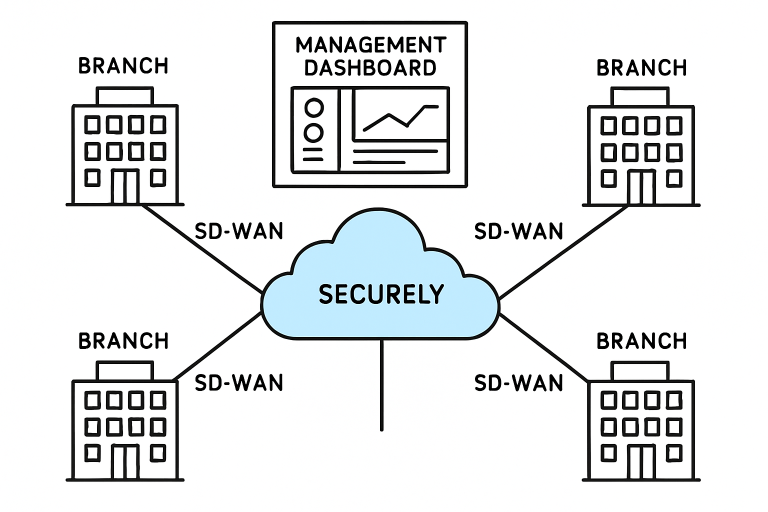
SD-WAN is revolutionizing the design, deployment, and management of wide area networks by offering a flexible, software-driven approach. As a virtual overlay, it separates the control plane from the data plane, enabling centralized management of networking devices, real-time traffic monitoring, and intelligent path selection. By dynamically routing traffic across multiple connection types—such as MPLS, broadband, 4G/5G, and LTE—SD-WAN ensures optimal performance, reliability, and redundancy. This approach reduces dependence on expensive, dedicated WAN circuits while improving scalability and network agility. Organizations benefit from enhanced application performance, simplified network operations, and the ability to adapt quickly to changing business and connectivity requirements.
Key Benefits of SD-WAN
- Cost Savings: SD-WAN reduces reliance on expensive legacy MPLS connections by enabling the use of more affordable broadband and cellular options. Businesses can lower network costs while maintaining, and often improving, performance.
- Agility and Fast Deployment: Centralized management and zero-touch provisioning enable the quick deployment of new sites or branches, with significantly reduced manual intervention and delays.
- Performance Optimization: Intelligent traffic steering prioritizes mission-critical applications, improving uptime and user satisfaction even in high-bandwidth, geographically dispersed environments.
- Scalability: Adding new locations or integrating new cloud resources becomes straightforward, making SD-WAN a foundational technology for expansion and digital transformation.
SD-WAN and Cloud Integration
The adoption of cloud services—SaaS, IaaS, and hybrid models—has outpaced the capacity and capabilities of traditional WANs. SD-WAN provides direct, secure, and reliable connectivity to cloud resources, drastically reducing the “trombone effect” where traffic is routed unnecessarily through central data centers. This results in lower latency and improved application performance. As Gartner notes, SD-WAN is pivotal for businesses undertaking large-scale cloud migrations or aiming to ensure optimal delivery of cloud-based applications.
Enhancing Security with SD-WAN
Next-generation SD-WAN solutions go beyond simple connectivity—they integrate security at every layer. Features such as end-to-end encryption, integrated firewalls, and segmentation restrict lateral movement, protecting data in transit between sites or in the cloud. Advanced offerings often include Secure Access Service Edge (SASE) technology, blending network and security functions into a unified, cloud-native platform. According to Forbes Tech Council, these converged solutions are essential as threats evolve and workforces become increasingly distributed.
Real-World Applications of SD-WAN
Organizations across various industries are already experiencing significant benefits from SD-WAN adoption. DHL, for example, successfully implemented SD-WAN in over 3,000 sites worldwide, achieving a 35% reduction in downtime—a critical advantage for global logistics operations. In the finance sector, Axis Bank introduced an SD-WAN solution across more than 5,000 branches, resulting in 25% faster onboarding for new locations and consistent policy enforcement for customer-facing applications. These examples demonstrate how SD-WAN can facilitate operational excellence and drive competitive differentiation.
Choosing the Right SD-WAN Solution
Choosing the right SD-WAN platform requires careful strategy, as not all solutions offer the same capabilities or performance. Enterprises should assess vendors by examining their underlying architecture, compatibility with existing infrastructure, built-in security measures, scalability, and the responsiveness of customer support. Leading platforms also offer advanced analytics, automation, and compliance features tailored to meet the specific needs of various industries and regulatory frameworks. To make a well-informed decision, organizations can review recent case studies, consult technology analysts, and gather insights from industry peers. This thorough evaluation process helps minimize risks, ensure long-term value, and position the enterprise for reliable, secure, and efficient network management.
Future Trends in SD-WAN
The SD-WAN market is undergoing rapid transformation, driven by emerging trends such as AI-powered network management, widespread 5G adoption, and the growing proliferation of Internet of Things (IoT) devices. Next-generation SD-WAN solutions are expected to enhance network resilience further, streamline operations through automation, and integrate seamlessly with edge computing, thereby reducing latency and delivering an enhanced user experience. As enterprises rely on increasingly complex, distributed infrastructures to support global operations, SD-WAN remains a critical component of modern networking strategies. Its ability to optimize traffic, improve security, and simplify management ensures businesses can maintain reliable connectivity while meeting the demands of a dynamic digital landscape.
Conclusion
SD-WAN is rapidly emerging as a foundational technology for modern enterprise networks, providing businesses with greater flexibility, efficiency, and control over their connectivity. By optimizing traffic routing, strengthening security protocols, and simplifying network management, SD-WAN enables organizations to easily support distributed workforces, cloud applications, and hybrid infrastructures. Its scalability allows companies to expand or adjust network resources without major disruptions, keeping operations agile in the face of digital transformation. When combined with careful implementation, continuous performance monitoring, and attention to evolving industry trends, SD-WAN empowers enterprises to maximize reliability, reduce costs, and fully leverage the benefits of a resilient, future-ready network architecture.
